From Lab Bench to Flight Line
Rugged Compute for Defence Test and Evaluation
In defence, testing and evaluation used to split neatly into two. In the lab, a rack of ordinary enterprise servers did the heavy lifting in an air-conditioned room. Out on the front line, aboard a vessel or in a mobile shelter, the equipment was rugged, conduction-cooled and built for the platform.
That split is getting harder to maintain. Modern AESA radars, digital EW receivers and multi-spectral EO sights generate huge volumes of data, with more of their behaviour defined in software and increasingly by machine learning. Testing them properly means recording at full rate, generating realistic scenarios and analysing results while the trial is still running. And it has to happen wherever the trial takes place, not just back at base.
In practice, that means taking data centre compute into places it was never designed to go.
Why Standard Servers Struggle in the Field
Enterprise servers assume a clean, stable, climate-controlled room. Put one in a test trailer on a range, on a flight-line cart or in a ship’s integration space, and the cracks show quickly. Cards and connectors work loose under vibration. Filters clog with dust. Heat builds up in shelters with limited cooling. And sometimes a full-depth data centre chassis simply won’t physically fit the rack it needs to go in.
The alternative is to go fully embedded with conduction-cooled OpenVPX technology, but the test bench, integration rig or data recorder around that system usually needs something different. It needs enterprise-class processors, large memory, plenty of standard PCIe slots and the freedom to run the same software stack as the development lab.
Powered by Dell. Hardened by HIPER.
The HIPER Global Rugged Edge AI Server Series is built for that middle ground. With a foundation built on Dell Technologies’ PowerEdge XR range, HIPER turns that into a mission system, with a custom chassis, ruggedisation, in-house environmental testing and the engineering support to see a programme through.
- HD-7620-X: based on the PowerEdge XR7620, with two Intel Xeon Scalable processors (up to 32 cores each), up to 2 TB of DDR5 and up to eight E3.S NVMe drives.
- HD-5610-X: based on the PowerEdge XR5610, with a single Xeon processor (up to 32 cores), up to 1 TB of DDR5, four front-accessible 2.5″ drive bays and 4 × 25GbE onboard.
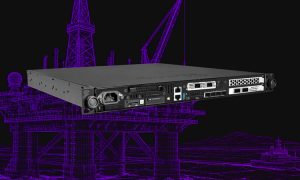 HIPER Global Rugged Edge AI Server Series – HD-7620-X |
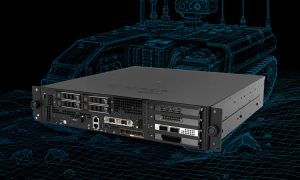 HIPER Global Rugged Edge AI Server Series – HD-5610-X |
Both take networking options from 1 Gb up to 200 Gb, in copper or fibre, through PCIe and OCP. Both also use Dell’s iDRAC9 and Redfish API for remote management, which matters when a test node sits in a container at the far end of a range. What HIPER Global adds is the part that turns a good edge server into something that fits a defence programme:
- Front or rear I/O: useful when a rack backs onto a bulkhead or vehicle wall.
- Mechanical retention: secure PCIe card supports, plus cable and module retention, to cope with shock and vibration.
- Cooling control: variable-speed fans with a proprietary RPM control board and a Low/Medium/High switch, so teams can balance airflow against acoustic noise.
- Auxiliary power: for discrete PCIe cards, ready for the GPU configurations planned for the series.
- Mounting: hole patterns for customer-specific rails, or Dell ReadyRails.
The platform operates from 0 to 50°C and survives -40 to 70°C in storage. Testing is designed around the specific military standards our customers need, including:
- MIL-STD-810H: operational and non-operational temperature and humidity
- MIL-STD-461F: EMI (CE102)
- MIL-STD-167-1: vibration, to tailored shipboard limits
- MIL-STD-901D: shock, 20G 50ms half sine
- MIL-STD-1399: shipboard AC electric power (Section 300B)
- MIL-STD-1474D and MIL-STD-740-2: airborne and structure-borne noise
Radar: Record Everything, Simulate the Rest
Radar integration rigs have two jobs: capturing what the radar sees and feeding it something realistic to look at.
On the capture side, AESA systems produce raw I/Q data at rates that quickly outgrow ordinary storage. With up to eight E3.S NVMe drives and up to 200 Gb networking, the HD-7620-X can record a full trial run, and its front-accessible drives make swapping media between sorties straightforward. The recordings can then be replayed back at base to refine clutter rejection and tracking algorithms.
On the stimulus side, hardware-in-the-loop rigs need to generate moving targets, clutter, Doppler shift and multipath in real time. Standard PCIe slots take the digitiser and FPGA cards that do the fast signal work, including the direct RF hardware that Sarsen Technology supplies. Meanwhile, the host processors compute the scenario.
Electronic Warfare: Dense Scenarios, Tight Timing
Testing an RWR, ESM or DRFM system means recreating a crowded, fast-changing RF environment. Dense streams of pulse descriptor words must reach signal generators or FPGA cards without gaps, and every node on the bench must agree on the time. The HD-5610-X’s onboard 25GbE supports Precision Time Protocol, which helps keep distributed test nodes in step.
Cognitive EW raises the bar further. When the system under test uses machine learning to recognise unfamiliar waveforms, the test rig needs to judge whether it adapted correctly, ideally during the run rather than days later. Running inference on the test cart makes that possible. Lighter models can run on today’s Xeon processors, and configurations are planned for heavier ones. On an open-air range, the adjustable fan control helps manage heat through long, dusty days. When something does need attention, externally accessible components mean it can be fixed in the field rather than shipped back to base.
Electro-Optics: Many Cameras, One Rig
Modern EO/IR sights combine day cameras, SWIR, MWIR and laser rangefinders in a single unit, and test rigs have to keep up with all of them at once. PCIe slots carry the frame grabbers for HD-SDI, CoaXPress or GigE Vision feeds. Fast NVMe storage means sustained multi-channel recording doesn’t become the bottleneck.
The more interesting work is testing automatic target recognition. Engineers inject synthetic scenes with smoke, flares, decoys and changing weather, then measure how quickly and reliably the sight detects and tracks. Because EO integration often happens in vehicles and trial vessels, the short-depth, custom-mounted chassis can go where the sensor is, rather than at the end of a long cable run.
Alongside VPX, Not Instead of It
None of this replaces embedded VPX. The deployed mission system still needs SWaP-optimised, conduction-cooled hardware built for the platform. But almost every programme also needs the integration benches, HIL rigs, ATE, data recorders and range processing that surround it. That’s where the Rugged Edge AI Server Series earns its place.
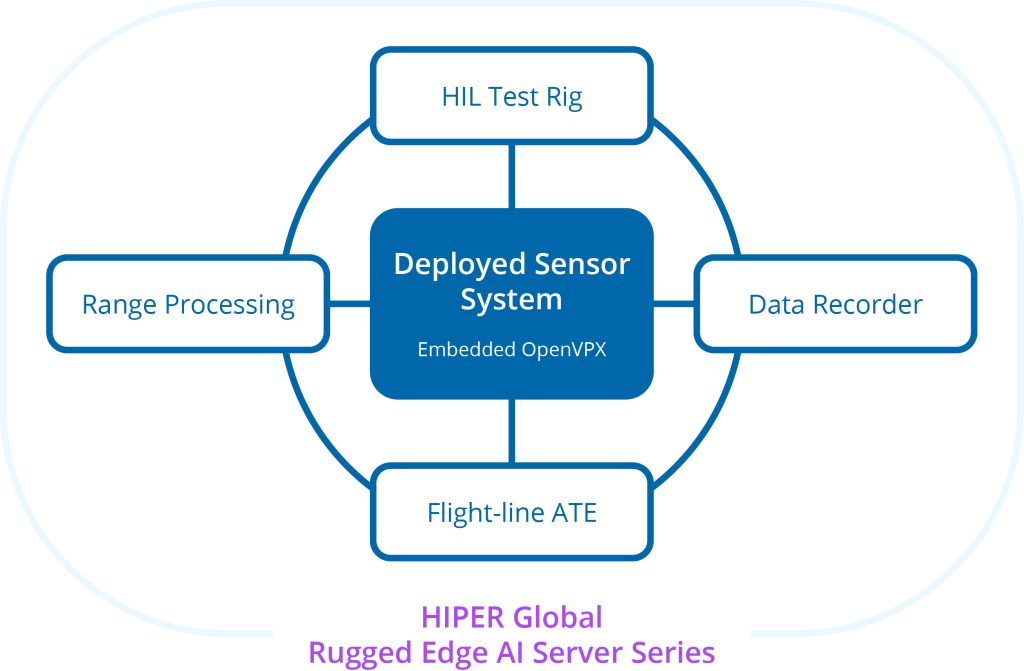
Between HIPER Global and Sarsen Technology, we can support both sides. And because the servers are built on the same Dell PowerEdge foundation many teams already use in the lab, moving software from development to the field means much less porting.
Built Around Your Programme
Sensors are getting smarter, trials are generating more data, and the gap between the lab and the field keeps shrinking. Test infrastructure has to keep up, and it rarely fits a standard box. Every system in the Rugged Edge AI Server Series is built around the customer’s mission, application and operating environment. The earlier we’re involved, the more we can shape it around your requirements, from chassis and I/O to cooling and qualification.